The trilogue agreement reached on 16 December brings targeted updates to the Corporate Sustainability Reporting Directive (CSRD) and the Corporate Sustainability Due Diligence Directive (CSDDD). The changes reshape sustainability reporting across EU member states, clarify expectations for non EU companies and refine the EU approach to due diligence in supply chains.
CSRD reporting: scope, timing and thresholds
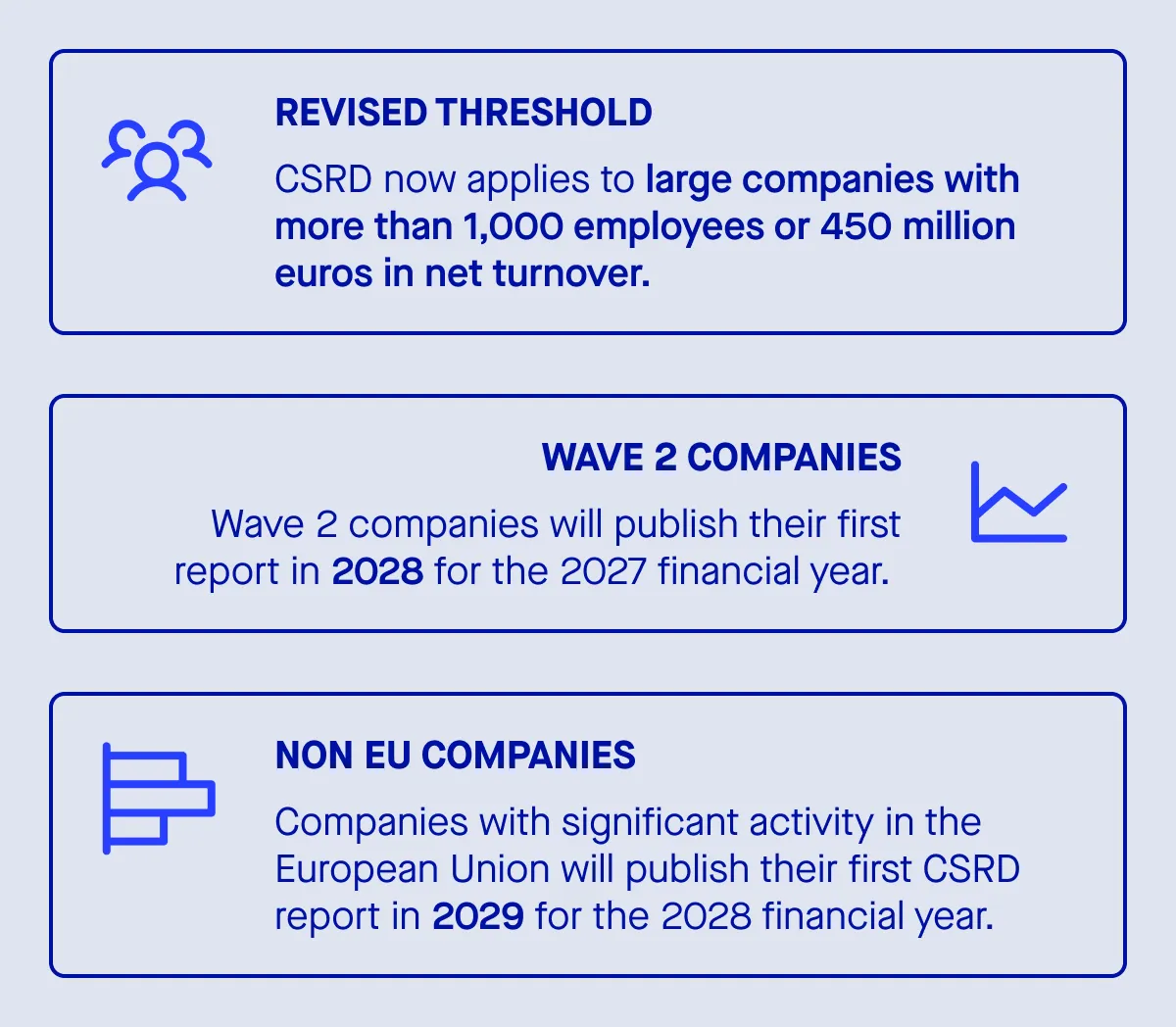
The revised threshold means the CSRD now applies to large companies with more than 1,000 employees and 450 million Euros in net turnover.
As previously announced, Wave 2 companies will publish their first report in 2028 for the 2027 financial year.
Non EU companies with significant activity in the European Union will publish their first CSRD report in 2029 for the 2028 financial year. Note, that under the revised thresholds, non-EU companies will fall into scope when they have an EU subsidiary or branch generating at least 200 million Euros in EU turnover and a consolidated EU turnover of at least 450 million Euros.
These changes streamline sustainability reporting requirements while preserving the core architecture of the Corporate Sustainability Reporting Directive and the European Sustainability Reporting Standards.
CSRD compliance for EU and non EU companies
The CSRD requires companies listed on an EU regulated market, as well as large EU companies meeting the new threshold, to disclose sustainability information in line with ESRS. Market participants, such as investors and financial institutions, rely on these disclosures to assess sustainability risks and opportunities.
CSRD reports must follow the European Sustainability Reporting Standards (ESRS). The ESRS for EU companies are currently being revised under a simplified approach, and the specific ESRS that non-EU companies will need to follow have not yet been published.
Double materiality
The CSRD continues to require a double materiality assessment covering financial materiality and impact materiality. This assessment helps companies identify and report on their sustainability performance, providing stakeholders with a clearer view of their environmental and social impacts. This determines which sustainability issues must be reported, including climate change, human rights, affected communities, marine resources, the environment and other strategic topics.
Value chain information
The trilogue outcome limits what companies can request from smaller suppliers in the value chain. Companies cannot require subcontractors with fewer than 1,000 employees to complete questionnaires beyond the VSME standard. The VSME standard is designed for very small and medium sized enterprises, ensuring proportional reporting requirements for these companies. If they ask for more, they must specify which information goes beyond the scope. The subcontractor may refuse. Other EU legislation, including due diligence rules, still applies.
An overview of CSRD changes
| Element | Now | Before |
| Scope threshold | More than 1,000 employees and €450M net turnover | Companies exceeding two of the following three thresholds: more than 250 employees, €50M in turnover, or €25M in total assets. |
| Non EU company inclusion | EU branch or subsidiary with €200M turnover and €450M EU turnover | Intended to apply to some non EU companies but details were unclear |
| Double materiality | Fully retained and central to determining ESRS disclosures | Same requirement under original CSRD |
| Value chain requests | Suppliers with fewer than 1,000 employees not required to provide information beyond VSME scope | No explicit cap on supplier data requests |
| Assurance | Limited assurance | Limited assurance moving toward reasonable assurance |
CSDDD: scope, timing and the refined due diligence framework
The trilogue outcome adjusts the Corporate Sustainability Due Diligence Directive to focus more clearly on risk based due diligence, proportionality for SMEs and alignment with international standards.
Timeline
The trilogue outcome also pushes back the implementation timeline for CS3D. Instead of applying from July 2027 as originally planned, the directive will now take effect in July 2029. This two year delay gives companies more time to prepare their due diligence systems
Scope and protections for smaller companies
CS3D will apply to companies with more than 5,000 employees and over €1.5B in global turnover. For non-EU companies, the directive applies when they generate more than €1.5B in net turnover within the European Union. The directive also introduces protections for smaller suppliers: large companies may request information from these SMEs only when it is genuinely necessary for due diligence. This reduces unnecessary administrative pressure on smaller businesses while ensuring that large companies can still address the highest risks in their value chains.
Article 8 risk based approach
Article 8 now confirms that companies may prioritise the highest risks rather than focusing first on tier 1 suppliers. Tier 1 can only be prioritised where the level of risk is equal. This brings the Directive closer to OECD due diligence guidance and supports meaningful action across complex supply chains.
Transition plan and civil liability
The requirement for transition plans has been removed from the CSDDD, but companies under the scope of the CSRD still have to disclose their transition plan when it exists. Civil liability has also been removed.
Sanctions and contract measures
Non-compliance with the directive may result in penalties up to 3 percent of global turnover. Contract suspension is possible but not mandatory: in case of adverse impacts, companies can continue the business relationship with the suppliers under certain conditions.
An overview of CSDDD changes
| Element | Now | Before |
| Risk based approach | Companies may prioritise based on severity and likelihood across the value chain | Less explicit prioritisation guidance, with perceived focus on tier 1 |
| Threshold | Over 5000 employees + a net global turnover of over €1.5 billion (for EU companies) or a net turnover in the EU of over €1.5 billion (for non-EU companies) | Over 1,000 employees + a net global turnover of over €450 million (for EU companies) or a net turnover in the EU of over €450 million (for non-EU companies) |
| SME protections | Engagement with SMEs only when information cannot be reasonably obtained by other means | Stakeholder consultations at the heart of the due diligence process |
| Transition plan | Removed from CSDDD. Addressed under CSRD | Requirement present in earlier drafts |
| Civil liability | Removed | Included in earlier legislative text |
| Sanctions | Up to 3 percent of global turnover. Contract suspension optional. | Defined by national laws, minimum 5% of net worldwide company turnover |
| Value chain engagement | Required but proportional to risk and capacity of suppliers | Required with fewer proportionality safeguards |
A new outlook for EU sustainability
The trilogue outcome marks a significant shift in the EU’s sustainability framework, refining both reporting and due diligence expectations while giving companies more clarity and time to adapt. With updated thresholds, streamlined requirements, and a more risk-based approach, organizations now have a clearer path to producing credible, consistent, and decision-useful sustainability information.
As the CSRD and CSDDD move toward implementation, companies that begin preparing early, strengthening their data, governance, and value-chain processes, will be best positioned to meet regulatory expectations and build long-term resilience.