Sustainability in Action 2026: New Report from Sweep and Capgemini

Read the report

Sweep Named a Leader in IDC MarketScape 2026 for Carbon Management

Get the report

Sweep named a Leader in the Verdantix 2026 Green Quadrant for enterprise carbon management

Get the report

EPR fees and packaging design: Turning material data into cost decisions

EPR fees: how to turn material data into cost decisions
Category
Blog
Last updated
November 23, 2026

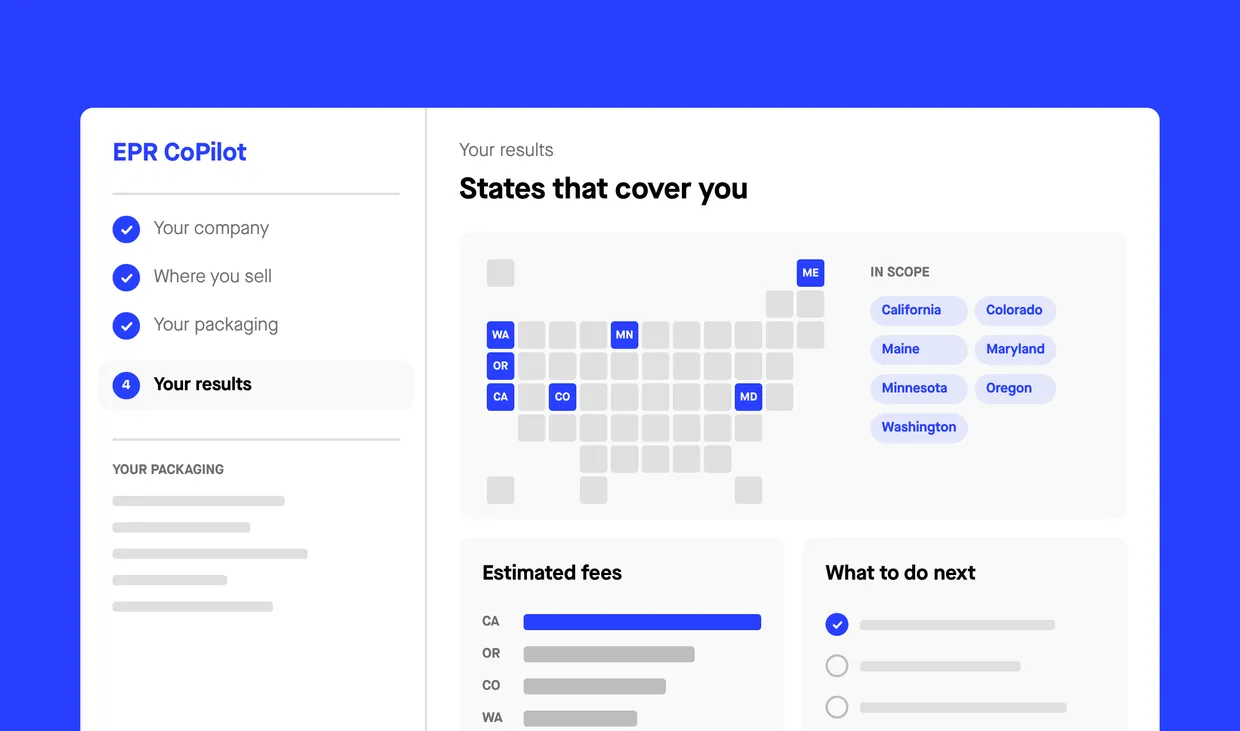
Packaging choices now come with a price tag. Seven US states have passed packaging extended producer responsibility (EPR) laws, and businesses will pay based on the materials they use.

Could a lighter design reduce those costs? Would switching materials actually save money? Or would it create a bigger expense elsewhere?

With the right data, businesses can answer these questions before committing to costly redesigns.

Does EPR apply to your business?

Not sure whether your business is subject to packaging EPR requirements? Read our guide to US EPR eligibility, state exemptions, and producer obligations →

Why packaging design now affects EPR costs

Packaging has traditionally been evaluated on material costs, product protection, transport efficiency, and customer experience. Does the packaging ensure the product stays undamaged? Is it cost-effective to manufacture and transport? Does its design meet customer expectations?

Now, extended producer responsibility (EPR) is adding another financial consideration – the cost of managing packaging after it’s used.

Under packaging EPR programs, producer fees depend on several factors:

  • Material type: Different packaging materials attract different fees based on their collection, processing, and recycling costs.
  • Packaging weight: Heavier packaging can result in higher fees where charges are calculated by weight.
  • Sales volumes: The quantity of packaging placed on the market determines a producer’s overall fee exposure.
  • Recyclability: Some programs use eco-modulated fees to reward materials with better recycling performance or discourage less recyclable alternatives.
  • Eco-modulated fees: Some programs adjust fees based on environmental characteristics, such as recyclability, recycled content, or other packaging design features.

Two packaging designs serving the same purpose can have very different EPR costs. A cheaper material might actually attract higher producer fees, while a more recyclable alternative could offer savings under certain state programs.

The financial implications extend beyond EPR fees, though. Packaging weight, manufacturing costs, and environmental performance all influence the overall business case, making it important to assess these factors together before designing or changing packaging.

As more US packaging EPR programs become operational, these costs are becoming an important part of packaging design and procurement decisions.

What packaging data do businesses need to estimate EPR fees?

Accurate EPR fee estimates depend on having a clear picture of the materials used in each product’s packaging. Businesses need to know which materials those are, how much they weigh, and how many units are sold in each relevant state.

This information helps producers classify their packaging and understand where their greatest costs may be.

Data required Why it matters
Material composition Identifies the packaging materials and components that fall into different EPR fee categories
Component weights Establishes how much of each material is placed on the market, supporting weight-based fee calculations
Sales volumes Determines the total quantity of packaging associated with products sold or distributed
Sales by state Helps businesses apply the appropriate EPR requirements and fee schedules in each market
Supplier specifications Provides supporting information about material composition, coatings, and other packaging characteristics
Recyclability and recycled content Helps assess potential fee adjustments under programs that incorporate environmental performance

For example, consider a food manufacturer selling 500,000 packaged products annually across several US states with EPR requirements. To estimate its potential producer fees, the business needs to identify the weight of each packaging component, including cardboard, plastic film, and labels, and determine how many units are sold in each state.

With this information, it can apply the relevant fee schedules to estimate its costs and identify which packaging materials will contribute most to its EPR expenses.

Under SB 54, producer responsibility follows a hierarchy, meaning if a business doesn’t meet the criteria at one level, responsibility moves to the next.

How Sweep can help with packaging data

Collecting consistent data becomes particularly important when packaging specifications are held by multiple suppliers and sales information is spread across different systems

Sweep, a sustainability intelligence platform, helps businesses centralize sustainability data from their value chains. With relevant material and environmental information in one place, procurement, finance, and sustainability teams can work from a shared understanding of their packaging portfolio.

How can packaging redesign reduce EPR fees?

As EPR fees become a growing consideration for businesses, packaging redesign is moving up the agenda. Some producers will need to modify their packaging to meet regulatory requirements, while others are exploring ways to protect profit margins and avoid unnecessary costs.

Only once businesses understand which materials contribute most to their EPR expenses can they identify opportunities to alter packaging design, whether that’s material weight, composition, or recyclability.

There are four approaches to this. 

  1. Reduce packaging weight: Lightweighting can lower weight-based fees by reducing the amount of material placed on the market. This might involve using thinner cardboard or reducing the size of packaging (without compromising product protection).
  2. Consider alternative materials: Switching materials may change the fee category applied to a product. Businesses can compare the EPR rates of suitable alternatives alongside their purchase prices, durability, and manufacturing requirements.
  3. Improve recyclability: Removing problematic coatings or redesigning difficult-to-recycle components could improve a package’s recycling performance. Where programs use eco-modulated fees, these changes could also influence producer charges.
  4. Explore reuse and refill: Reusable containers and refill systems can reduce reliance on single-use packaging. Their financial benefits depend on how frequently packaging is reused, the system’s operating costs and the applicable EPR rules.

Why a lower EPR fee doesn’t always mean lower packaging costs

While a lighter or more recyclable design might attract lower EPR fees, it could require more expensive materials or new manufacturing equipment, and actually increase production costs. Any redesign or changes to packaging can also affect product protection or transportation efficiency and could potentially increase environmental impacts across the packaging lifecycle.

The most effective approach is to compare the total costs and benefits of each option before committing to a change. This allows teams to identify designs that support both financial and sustainability objectives.

How to compare packaging redesign costs before making a change

Before changing packaging materials or specifications, procurement, finance, and sustainability teams need to assess how a redesign could affect their EPR fees and overall costs. 

From packaging data to a commercial decision

The process can be broken down into four steps:

1. Understand your packaging portfolio

Identify the materials, component weights, suppliers, and quantities sold across relevant markets.

↓

2. Estimate current EPR costs

Apply the appropriate state fee schedules to establish the costs associated with existing packaging.

↓

3. Compare packaging alternatives

Evaluate changes in material weights, composition, or recyclability and calculate how these could affect producer fees.

↓

4. Make an informed decision

Balance estimated EPR savings against material costs, manufacturing requirements, product performance, and environmental impacts.

This approach allows businesses to prioritize packaging changes based on their potential commercial and environmental benefits, rather than focusing on EPR fees in isolation.

A worked example using California EPR fees

Let’s say a food manufacturer sells five million products annually in California, each packaged in a cardboard box weighing 0.15 pounds. The company is considering a redesign that would reduce the box’s weight by 20% without changing its material classification.

Using Circular Action Alliance’s preliminary 2027 California EPR fee schedule, which lists a base fee of $0.03 per pound for cardboard without plastic components, the potential savings can be estimated as follows:

Cost factor Current packaging Redesigned packaging
Annual units sold 5,000,000 5,000,000
Packaging weight per unit 0.15 lb 0.12 lb
Total annual packaging weight 750,000 lb 600,000 lb
Applicable EPR rate $0.03/lb $0.03/lb
Estimated annual EPR fees $22,500 $18,000

The redesign could reduce the company’s annual EPR fees by $4,500, assuming sales volumes and the applicable fee rate remain unchanged.

However, this saving must then be weighed against the cost of developing, testing, and manufacturing the lighter packaging. If the redesign requires more expensive materials or equipment, the overall financial benefit may be smaller or even negligible.

That’s why EPR savings should form part of a broader packaging cost assessment, and not be the overriding objective. The cost of materials, manufacturing changes, product protection, transportation, and environmental impacts must be considered before approving any redesign.

Turn packaging data into better decisions with Sweep

As EPR fees become a recurring cost of doing business, companies can no longer afford to make packaging decisions using fragmented spreadsheets or outdated environmental data. With potentially thousands of products and packaging components to assess, identifying opportunities to protect margins becomes increasingly difficult without the right systems in place.

Sweep gives businesses the sustainability intelligence needed to make these decisions with confidence. 

Key capabilities include:

  • Centralized sustainability data: Bring environmental information from across your business into one place, reducing reliance on disconnected spreadsheets and inconsistent datasets.
  • Supplier collaboration: Engage suppliers to collect more accurate material and environmental information, helping teams evaluate packaging alternatives using reliable inputs.
  • Environmental performance tracking: Monitor relevant sustainability indicators to understand how changes in materials, sourcing, or packaging design affect environmental performance.
  • Product carbon footprint analysis: Use product carbon footprint (PCF) assessments to understand how packaging changes may influence emissions across a product’s lifecycle, helping avoid decisions that reduce EPR fees while increasing environmental impacts.
  • AI-powered analysis with Sweepy: Use Sweepy’s AI capabilities to analyze sustainability information, identify data gaps, and surface insights that support better decisions.

As EPR costs put greater pressure on packaging budgets, the ability to identify worthwhile changes quickly becomes a competitive advantage. 

Sweep helps businesses turn sustainability data into decisions that protect margins while keeping environmental performance firmly in view.

Sweep can help

Sweep makes sustainability work for your business. Not the other way round. We connect all your sustainability data and turn it into business intelligence to help you unlock performance – from compliance and risk reduction, all the way to cost-savings, and market differentiation.

With Sweep, you can:

  • Lower costs through real-time tracking and insights
  • Strengthen supply chains with end-to-end visibility and engagement
  • Deliver audit-ready sustainability and climate reporting with confidence
  • Make sustainability intelligence available to everyone to optimize the business
See how we can help you on your sustainability journey