Sweep Named a Leader in IDC MarketScape 2026 for Carbon Management

Get the report

Sweep named a Leader in the Verdantix 2026 Green Quadrant for enterprise carbon management

Get the report

Discover the major challenges and opportunities that global companies are facing today.

Read the report

🇫🇷
Bonjour! We noticed you speak French.

Would you like to browse our site in French?

Sweep x Climate Contribution Framework at LCAW 2026: The missing layer

LCAW CCF
Category
Blog
Last updated
June 26, 2026

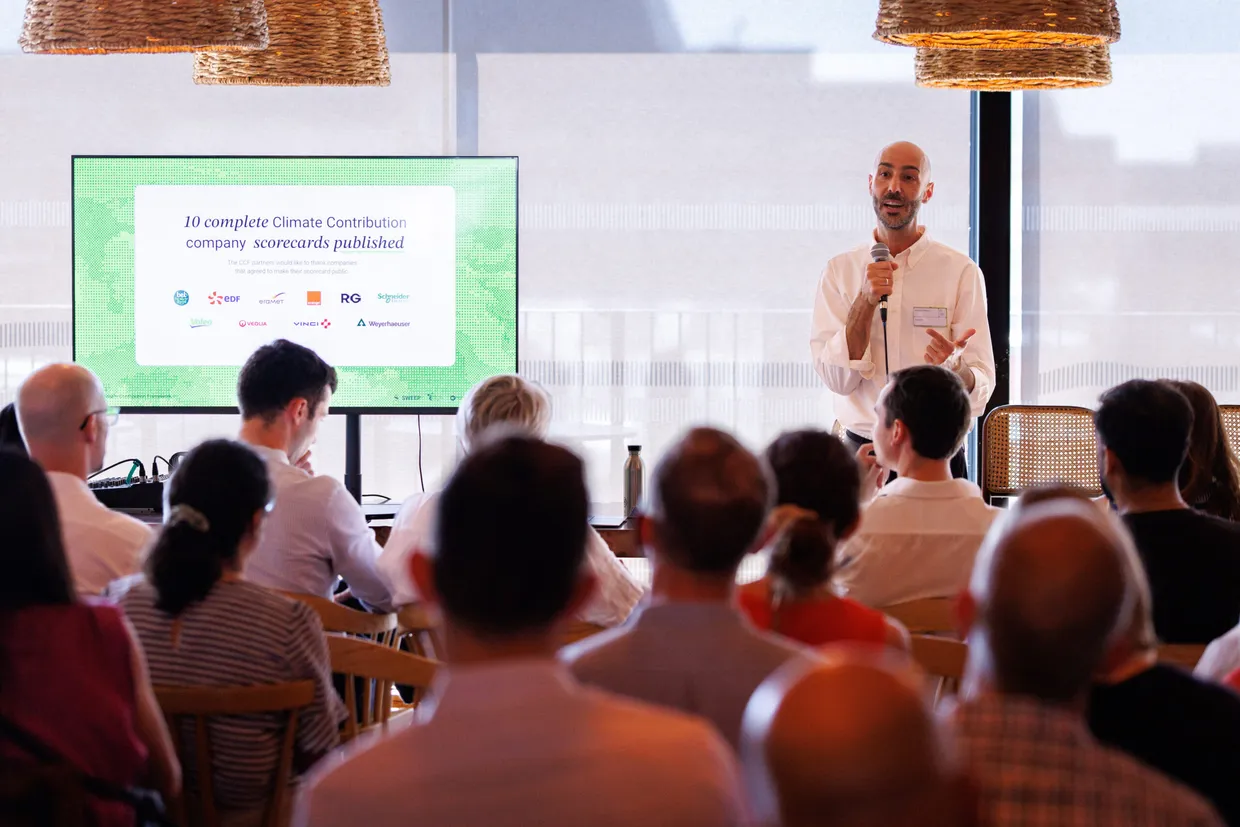
On Day 4 of London Climate Action Week 2026, Sweep brought together researchers, policymakers, sustainability leaders and corporate pioneers at The Conduit to mark a significant milestone: the publication of the first 10 company reports using the Climate Contribution Framework (CCF)

The programme included an introduction to CCF’s architecture by Renaud Bettin (VP Climate Action at Sweep), a keynote from Angel Hsu (Associate Professor, University of North Carolina at Chapel Hill), a panel discussion moderated by Brad Schallert of Winrock International, and a live CCF scorecard walk-through with EDF Group’s Carine de Boissezon. The throughline across all four sessions? Climate measurement needs to go further than CO2 emissions.
1. Net zero is not dead, but credibility is in crisis

Angel Hsu, founder of the Data-Driven EnviroLab at the University of North Carolina at Chapel Hill and co-lead of the Net Zero Tracker, set a clear-eyed tone in her keynote. Despite persistent media narratives suggesting companies are walking away from net zero commitments, the data tells a rather different story. Of the Forbes 2000 companies tracked since the 2021 surge in pledges, only 17 have genuinely backtracked. Meanwhile, 850 have held firm, 172 have adopted new targets, and 86 have actually strengthened their commitments.

“Net zero is alive and well. Companies have not just reversed course overnight.”

But having a pledge is not the same as having a credible plan. Angel Hsu’s research shows that 96% of companies with net zero commitments are at risk of failing on at least one credibility indicator, whether that is scope three coverage, near-term action plans, or clarity on the role of offsets. The fellowship of net zero has formed. Now comes the harder work of the journey.

2. Emissions alone are not enough, and the frameworks are catching up

A recurring theme across both the keynote and the panel discussion was the fundamental inadequacy of emissions-only measurement. For high-growth companies, solution providers and technology manufacturers, fixing your gaze solely on absolute emissions can paradoxically disincentivise the very actors we need most.

Esther Finidori, Chief Sustainability Officer at Schneider Electric (named the world’s most sustainable company by Time and Statistica in both 2024 and 2025), spoke plainly about what practitioners need from standards:

“A daunting question is: is it good enough? Am I going fast enough? Where am I missing out on something? These standards help you do that. And if they are ill-designed, it can have serious consequences: poor decisions in companies, wrong prices.”

Schneider Electric has been a sponsor of the CCF initiative from day one and is among the first to release a contribution score. The company has also been publishing externally accounted figures for the CO2 saved and avoided by its technologies for customers for a decade, yet can only calculate this across 20 to 25% of its turnover due to the challenge of documenting robust baselines. The message was clear: the shift from disclosure and commitment to genuine accountability on implementation is where the real work lies, and frameworks must support that shift.

3. Avoided emissions deserve a seat at the table

One of the most substantive conversations of the afternoon centred on avoided emissions, sometimes referred to as Scope 4. Marvin Henry, Director of Climate Action at WBCSD, made the case plainly: the economy will not decarbonise through inventory reductions alone. We also need to understand which solutions, deployed in which contexts, can accelerate systemic change.

“We need to understand what type of solutions and in which kind of contexts we need to scale in order to accelerate decarbonisation on a systemic level. If we do not use concepts like avoided emissions, we cannot make meaningful assessments of which technologies can really drive faster change.”

The credibility challenge around avoided emissions is real. Inflated baselines and weak disclosure have long undermined the concept. Marvin Henry argued that the path forward lies in harmonised, transparent methodologies with regular updates, so that assessments remain valid as technologies evolve. Critically, the CCF addresses this by anchoring avoided emissions within a broader framework: companies must first demonstrate credibility on their own footprint before avoided emissions contributions are factored in.

4. The live scorecard: EDF

The afternoon closed with a live walk-through of a CCF scorecard using real data from EDF. As the world’s largest producer of electricity with very low direct carbon emissions, EDF illustrated precisely why a purely emissions-based lens tells only part of the story. 

The session moved through each pillar in turn, drawing on CDP, SBTi, TPI, EU Taxonomy, avoided emissions from electrification programmes, and climate finance instruments including a 240 million euro electrification fund. 

Ten companies have now agreed to make their contribution scores publicly available. This is the moment the framework moves from theory into the market.

About the Climate Contribution Framework 

The Climate Contribution Framework is a unified climate performance standard that turns 50+ existing frameworks into one comparable score. It does not replace SBTi, CDP, EU Taxonomy, TPI or ACT. It unifies them.

How it works

Companies are assessed across three pillars:

  • A. Minimise Footprint: Scope 1, 2 and 3 emissions reduction and transition planning
  • B. Scale Solutions: Green revenues, low-carbon products, avoided emissions 
  • C. Finance Beyond: carbon credits, climate funds and philanthropy outside the value chain

Why it’s different

  • Pillar weightings are adjusted by sector, so a steelmaker and a tech start-up are judged on what actually matters in their industry
  • Scores are expressed as a percentage of a company’s contribution potential, making them comparable across sectors

Who built it

Sweep and Minova Research Centre, with I Care by Bearing Point and Winrock International

Where it stands

Integrated into the Action Agenda Activation Group 23 of COP30. 

Live at climatecontributionframework.org

Sweep can help

Sweep makes sustainability work for your business. Not the other way round. We connect all your sustainability data and turn it into business intelligence to help you unlock performance – from compliance and risk reduction, all the way to cost-savings, and market differentiation.

With Sweep, you can:

  • Lower costs through real-time tracking and insights
  • Strengthen supply chains with end-to-end visibility and engagement
  • Deliver audit-ready sustainability and climate reporting with confidence
  • Make sustainability intelligence available to everyone to optimize the business
See how we can help you on your sustainability journey